
“How many fixtures can one DMX recorder control?” sounds like a simple question, but fixture quantity alone cannot answer it. One basic RGB light may use three DMX channels, while one moving light in an extended personality may use 24, 32, or more. The correct calculation starts with the selected DMX mode and patch, then turns the total channel requirement into universes.
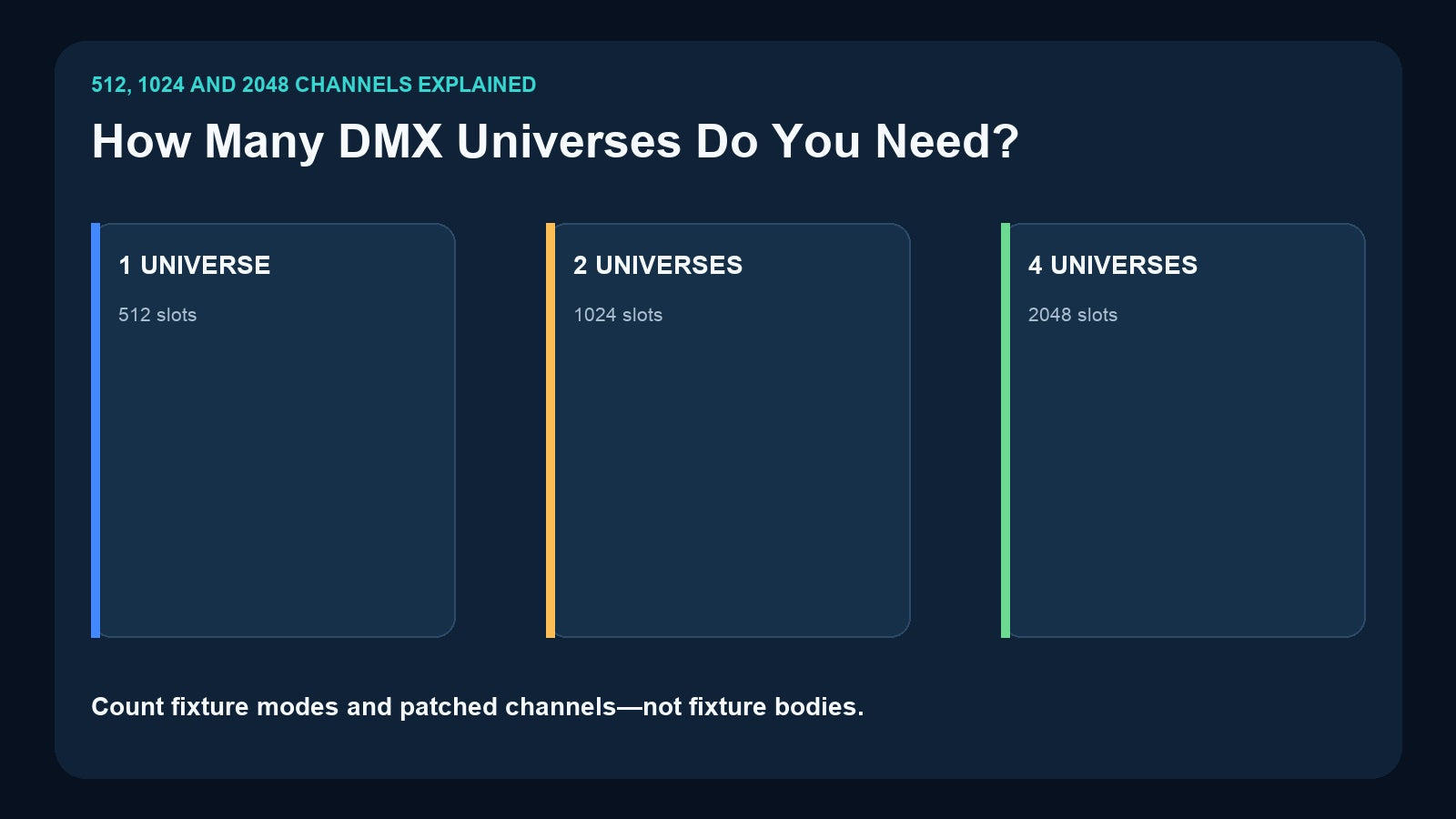
One DMX universe provides up to 512 control slots. Two universes provide 1024, and four provide 2048. This guide explains how to calculate the real requirement and match it to a recorder without buying too little—or choosing unnecessary capacity.
What Is a DMX Universe?
A DMX universe is one independent set of up to 512 channel slots. Channel addresses normally run from 1 to 512 inside that universe.
Each fixture listens to a starting address and uses a block of consecutive channels based on its selected personality. A simple dimmer might use one channel. An RGB PAR might use three. An RGBW fixture might use four or more. A moving head can use many channels for pan, tilt, intensity, color, gobo, focus, prism, speed, and control functions.
When the first group of 512 slots is no longer enough, the next fixtures must be assigned to another universe and receive data through a separate DMX output or a network node mapped to that universe.
The address “1” can therefore exist in Universe 1 and Universe 2 at the same time. They are different signal spaces, just as apartment 1 can exist in two different buildings.
Why Fixture Quantity Is Misleading
The channel mode matters more than the fixture body.

Consider three simplified examples:
- 100 RGB fixtures in 3-channel mode use 300 channels and fit in one universe.
- 100 RGBW fixtures in 4-channel mode use 400 channels and also fit in one universe.
- 20 moving lights in 24-channel mode use 480 channels, nearly filling one universe.
Now change the moving lights to a 32-channel extended mode. Twenty fixtures would require 640 channels, so the patch must use at least two universes.
Worked patch: twenty 32-channel moving lights
Sixteen lights use 16 × 32 = 512 addresses and fill Universe 1. Put the remaining four on Universe 2, where they use 4 × 32 = 128 addresses. Each universe starts its own address count at 1:
| Universe | Fixtures | Example start addresses | Used addresses |
|---|---|---|---|
| 1 | Lights 1–16 | 1, 33, 65 … 481 | 1–512 |
| 2 | Lights 17–20 | 1, 33, 65, 97 | 1–128 |
Universe 2 has 384 unassigned addresses after this patch. That space can only be used by fixtures actually connected or mapped to Universe 2; it is not an extension of Universe 1. Check the selected fixture personality and connector plan before finalizing the patch.
This is why a product description saying “controls many fixtures” is less useful than a clear channel and universe rating. Always obtain the current fixture manual and confirm the exact personality intended for the show.
The Basic Calculation
For each fixture type:
quantity × channels per fixture = channels required
Then add the requirements for every fixture group. For example:
- 24 RGBW PARs × 4 channels = 96
- 12 moving heads × 24 channels = 288
- 8 LED battens × 12 channels = 96
- 4 dimmer channels × 1 channel = 4
Total: 484 channels
On paper, this fits inside one universe. However, the actual patch must also account for starting addresses, reserved spaces, fixture-mode changes, and practical expansion. If several new fixtures are already planned, two universes may be the more sensible system design.

Build a Patch Worksheet First
Do not choose the recorder from a rough fixture count. Build a patch worksheet.

Step 1: List fixtures and quantities
Record the model, quantity, location, and purpose of each fixture group. Include dimmers, relays, effects, and architectural devices that consume DMX addresses.
Step 2: Select the operating personality
Choose the DMX mode that will actually be used. A fixture may offer basic, standard, and extended personalities with very different channel counts. Do not calculate from the largest mode unless that is the mode you plan to patch.
Step 3: Assign starting addresses
Give each fixture a starting address and confirm that its full channel block fits before address 512. Document the universe for every fixture.
Step 4: Add realistic headroom
Include known additions and a practical amount of spare capacity. Headroom should reflect the project, not a fixed percentage copied from another installation. A finished touring package may need little expansion space; a venue planning future fixture additions may need more.
Do Not Split One Fixture Across Universes
For a fixture using a standard single-input DMX personality, keep its full channel footprint inside one universe. If a complex fixture uses multiple distinct DMX inputs or network universes, follow its manual and patch each input separately.

Suppose a moving light uses 24 channels. Starting it at address 489 uses addresses 489–512 and fits exactly. Starting it at address 500 would require addresses beyond 512, which do not exist in that universe. Move the fixture to the next universe and assign a valid starting address there.
This can leave unused slots near the end of a universe. That is normal. Efficient patching matters, but a clear and serviceable system is more important than forcing every slot to be occupied.
One Universe: Up to 512 Channels
One universe is often enough for compact installations, especially when fixtures use economical personalities. It may suit small stages, worship spaces, retail displays, bars, photo studios, meeting rooms, and architectural zones.
For recording changing one-universe content, the DR & PB MINI records up to 512 channels to microSD and supports Record IDs 1–255. It is appropriate when the content includes fades, movement, or other timed DMX changes.
If the installation only needs a few static looks, universe capacity may not be the main decision. The CM003 captures scene data and provides five physical buttons with up to ten press/release actions. Choose it for the scene-control workflow, not as a substitute for a timeline recorder.
Two Universes: Up to 1024 Channels
Two universes fit installations that exceed 512 channels but do not need a four-universe network system. This range is common when a rig includes multiple moving-light groups, larger LED installations, or separate stage and room zones.
The DR & MP 1024 supports two universes and 1024 channels. It also provides stored music playback, up to 255 programs, single or loop modes, and auto-resume of the last active program after a power interruption.
Two universes are not automatically better than one. Choose this level when the documented patch or music-led workflow requires it.
Four Universes: Up to 2048 Channels
Four universes suit larger stages, multi-zone installations, networked venues, exhibitions, and projects where Art-Net distribution is already part of the architecture.
The 4-Universe Art-Net DMX Recorder/Player handles four Art-Net universes, or 2048 channels. It records to microSD, plays shows independently, and converts Art-Net to four physical DMX outputs. It can therefore serve as both recorder and output node.

The CM002 also provides four DMX inputs and four outputs, but its main decision factors are app operation, audio outputs, and TCP/UDP/RS485 integration for fixed control systems. “Four ports” and “four Art-Net universes” describe different system architectures, so review the required signal path as well as the channel count.
Can a DMX Splitter Add Another Universe?
No. A DMX/RDM splitter distributes the same universe to several physical cable runs. It can help organize fixture branches and, on models with optical isolation, contain some electrical faults. It does not create a second independent set of 512 addresses. Four splitter outputs do not mean four universes.
To use another universe, the controller or recorder must generate it, and the fixtures must receive it through a separate DMX output or a network node port assigned to that universe. If you need more cable branches for one existing universe, compare Pknight RDM splitters and signal amplifiers. If you need to bring separate Art-Net or sACN universes onto physical DMX outputs, compare Pknight Art-Net & sACN nodes and verify each model's protocol support and port mapping.
How Much Spare Capacity Should You Leave?
There is no universal headroom percentage that fits every project. Use a documented expansion plan.

Separate the calculation into:
- Channels used by the current approved patch
- Channels needed by additions that are already known
- Practical spare space for likely changes
Also consider physical output locations. Even if two areas fit mathematically inside one universe, separate universes may simplify cabling, troubleshooting, ownership, or network routing. Conversely, do not divide a small system into many universes only to make the specification look larger.
Common Calculation Mistakes
Avoid these errors:
- Counting fixtures without checking their DMX personalities.
- Assuming every fixture uses its smallest or largest mode.
- Forgetting dimmers, relays, effects, and house-light devices.
- Allowing a fixture’s channel block to run past address 512.
- Confusing a physical DMX output with an unlimited number of network universes.
- Choosing capacity without checking what type of content the recorder stores.
- Ignoring future fixture additions that are already in the project plan.
Frequently Asked Questions
Does one DMX universe always contain 512 usable channels?
It provides up to 512 slots. The actual number used depends on the patch, fixture modes, and address layout.
Can two fixtures use the same address?
Yes, if they are intended to respond identically and use compatible personalities. They will no longer be independently controllable.
Can Universe 1 and Universe 2 both use address 1?
Yes. Each universe has its own 1–512 address space.
Should I buy four universes for future-proofing?
Only when the planned patch, expansion, physical outputs, or network design justifies it. A clear one- or two-universe system can be easier to commission and maintain.
Final Recommendation
Calculate universes from the actual fixture modes and patch, not from fixture quantity. Keep every fixture’s complete channel block inside one universe, add realistic expansion room, and then match the result to the content and transport workflow.
For one-universe timed playback, consider DR & PB MINI. For two universes with stored music, consider DR & MP 1024. For four-universe Art-Net recording and DMX node output, consider the 4U Art-Net Recorder/Player. Then use Which DMX Recorder Do You Need? to compare operator interfaces and integration requirements—not channel capacity alone.
Need help matching a recorder to your DMX system? Review the linked product pages or contact Pknight with your universe count, signal type, playback content and preferred trigger method.