
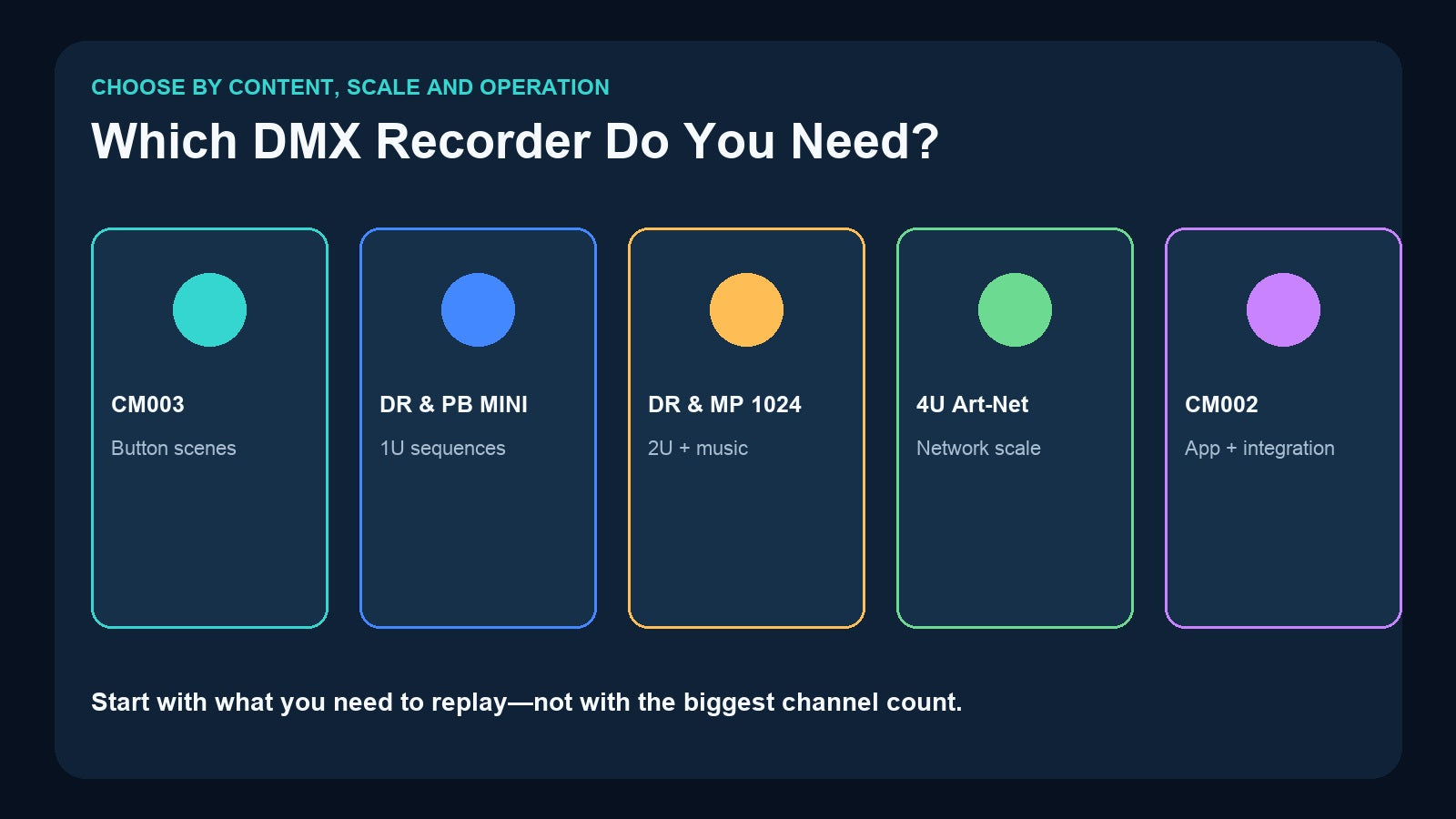
A DMX recorder is not simply a box with a certain number of channels. The right choice depends on what must be recorded, how many universes are involved, who will operate the system, and what needs to trigger playback.
A five-button scene controller can be more useful than a four-universe recorder when restaurant staff only need instant access to a few looks. A one-universe timeline recorder can be the perfect solution for a moving-light routine. A music player or network recorder becomes important only when audio, scale, or system integration demands it.
This guide compares five Pknight workflows: CM003, DR & PB MINI, DR & MP 1024, the 4-Universe Art-Net DMX Recorder/Player, and CM002.
First Decide What You Need to Replay
Before counting channels, identify the content:
- Static scenes: one captured set of DMX values, such as “Dinner,” “Presentation,” or “Cleaning.”
- Timed sequences: fades, movement, color changes, and effects that must unfold the same way every time.
- Music-led shows: lighting content that must play with a stored audio track.
- Networked multi-universe content: larger shows distributed over Art-Net and converted to physical DMX outputs.
- Integrated venue control: playback selected from an app, central controller, or AV automation system.

If you are still unsure about the terminology, read DMX Scene vs Sequence vs Show. The key rule is simple: a static state needs scene storage; movement and timing need timeline storage.
At a Glance: Five Products, Five Different Jobs

| Product | Best fit | Capacity / scale | Main operating style |
|---|---|---|---|
| CM003 | Fast recall of static scenes | 5 buttons, up to 10 scene actions | Physical buttons |
| DR & PB MINI | Compact timed DMX playback | 1 universe / 512 channels, IDs 1–255 | Local controls or external DMX |
| DR & MP 1024 | Timed lighting with stored music | 2 universes / 1024 channels, up to 255 programs | Local player, optional wireless trigger/app |
| 4U Art-Net Recorder/Player | Network recording plus DMX node output | 4 universes / 2048 channels | Art-Net, local playback, external DMX |
| CM002 | Fixed-install recording and system integration | 4 DMX inputs and 4 outputs | App, local playback, TCP/UDP/RS485 |
These products overlap in some applications, but they are not simply small, medium, and large versions of the same design.

Choose CM003 for Simple Physical Scene Recall
The CM003 5-Button Scene Controller is the best fit when the required result is a group of static lighting states and the operator needs an obvious physical interface.
It can capture scene data from DMX512, Art-Net, or sACN. Five buttons can each have an On Press and On Release action, giving up to ten programmable scene actions. Once configured, the unit plays scenes without requiring the original console.
Choose CM003 when:
- Staff need labeled buttons instead of a technical menu.
- The desired looks are static.
- Fast, repeatable cue recall matters more than timeline recording.
- You want a compact wall, desk, or control-point interface.
Do not choose CM003 as the only recorder when the effect includes a timed fade, moving-light path, or color sequence. It stores the output state, not the full changing timeline. It can, however, act as a simple third-party trigger for a separate sequence recorder.
Choose DR & PB MINI for One-Universe Sequences
The DR & PB MINI is a compact choice when you need to capture and repeat a changing DMX program within one universe.
It records up to 512 DMX channels to a removable microSD card and supports record IDs from 1 to 255. The stored .dmx files preserve the incoming channel changes over time. Playback can be selected locally or from external DMX. In its external two-channel personality, the first channel selects a program and the second sets the playback dimming level.
Choose DR & PB MINI when:
- The installation uses one DMX universe.
- The effect contains fades, movements, chases, or other timed changes.
- You want removable storage and simple backup of recordings.
- Another controller needs to select recorded programs over DMX.
- You do not need synchronized stored audio from the recorder itself.
It is a strong fit for small stages, retail displays, architectural effects, compact attractions, and venues that want to remove the programming console after setup.
Choose DR & MP 1024 for Two Universes and Music Playback
The DR & MP 1024 expands the workflow to two universes, or 1024 channels, and adds stored music playback.
It supports up to 255 programs and multiple playback behaviors, including a single run based on the music track or DMX program duration, continuous loop playback, and automatic resumption of the last active program after a power interruption. A removable 32GB microSD card makes it practical to back up and transfer content. An optional USB wireless trigger and app can be used when remote selection is preferable to front-panel operation.
Choose DR & MP 1024 when:
- One universe is not enough, but four would be unnecessary.
- The lighting must play with a stored music track.
- Loop playback or resume-after-power-loss behavior is important.
- The application is a dance room, small performance space, themed event, party venue, or synchronized attraction.
Do not pay for music functionality merely because audio exists somewhere in the venue. Choose it when the recorder itself needs to manage the relationship between the stored track and the lighting program.
Choose the 4U Art-Net Recorder for Network Scale
The 4-Universe Art-Net DMX Recorder/Player combines a recorder/player with a four-port Art-Net-to-DMX node.
It handles four Art-Net universes, up to 2048 channels, records content to microSD, and provides standalone playback through four physical DMX outputs. It can also use a selectable DMX input, and the outputs are RDM-ready. Network setup supports DHCP or manual IP configuration. External DMX playback uses two control channels: one selects shows 1–255 and the other sets dimming.

Choose the 4U Art-Net Recorder/Player when:
- The show exceeds two universes.
- Content already travels over Art-Net or the installation is designed around Ethernet.
- You need recording, standalone playback, and four DMX output ports in one device.
- The device must also serve as a network-to-DMX output node.
- RDM-ready output ports are valuable for the installation.
This product is not only a larger recorder. Its network-node role is a major part of the decision.
Choose CM002 for Fixed-Installation Control and Integration
The CM002 4-Port DMX512 Recorder Player is aimed at fixed installations that need local recording plus flexible control-system integration.
It provides four DMX512 inputs and four outputs, records complete lighting data from a console to TF card, and supports standalone loop or one-touch playback. The CM-Pro mobile/tablet app adds wireless recording, editing, and playback control. Audio outputs support music-oriented applications, while TCP, UDP, and RS485 commands allow integration with central-control, AV, and smart-venue systems.
Choose CM002 when:
- The installation uses physical DMX inputs and outputs across four ports.
- A mobile app should manage recording or playback.
- A central-control or AV system needs to issue network or serial commands.
- The venue is a banquet hall, bar, theater, exhibition, landscape project, or multipurpose event space.
- The recorder is part of a larger permanent-control system rather than a standalone operator box.
CM002 is the integration-oriented choice. If the project is purely Art-Net distribution, the 4U Art-Net Recorder may be more direct. If the only goal is one-universe timeline playback, DR & PB MINI is simpler.
How Many Universes Do You Actually Need?

Count patched channels, not fixture quantities. Twenty simple RGB fixtures may use fewer channels than four moving lights in an extended personality.
Leave reasonable room for the actual patch, but avoid selecting a recorder only because it has the highest number. The practical scale is:
- CM003: scene-oriented capture and recall; define the address range and channels needed for each scene.
- DR & PB MINI: one universe / 512 channels.
- DR & MP 1024: two universes / 1024 channels.
- 4U Art-Net Recorder/Player: four universes / 2048 channels.
- CM002: four physical DMX input/output paths, selected mainly for integration and fixed-install workflow.
Universe count alone does not tell you whether the product records static scenes, timed DMX, music-led content, or network data. Always combine scale with content type.
Who Will Operate the System?
The daily operator should influence the hardware choice as much as the programmer.

- Choose CM003 when staff should press a clearly labeled physical button.
- Choose DR & PB MINI or DR & MP 1024 when a technician can select programs from a dedicated player or another DMX controller.
- Choose CM002 when app control or central AV integration is part of the operating plan.
- Choose the 4U Art-Net Recorder/Player when network distribution is central to the system architecture.
If a powerful recorder is difficult for staff to operate, add a simple control layer. For example, CM003 can send the external DMX selection values used by DR & PB MINI, letting the recorder store the complex sequence while the operator sees only a few buttons.
Frequently Asked Questions
Do I need more recorder channels than my current patch uses?
Allow sensible room for the real installation, but choose by planned universes and workflows rather than buying the largest model automatically.
Which recorder is best for a moving-light show?
For one universe, DR & PB MINI records the changing DMX timeline. Use DR & MP 1024 for two universes with music, or the 4U Art-Net model when the network show reaches four universes.
Which product is easiest for non-technical staff?
CM003 offers the most direct physical-button workflow for static scenes. A button controller can also provide a simple trigger layer for a separate recorder.
Which model fits a central AV control system?
CM002 is designed for integration through TCP, UDP, and RS485 commands as well as app-based operation. Confirm the command and network design during system commissioning.
Final Selection Checklist

Before ordering, confirm:
- Static scene or timed sequence?
- One, two, or four universes?
- Must the device store and play music?
- DMX512, Art-Net, sACN, or a combination?
- Physical buttons, front-panel controls, external DMX, app, or AV automation?
- Is removable storage and file backup required?
- What should happen after power loss?
- Does the recorder also need to act as a node or central-control endpoint?
The shortest recommendation is:
- CM003: choose it for simple physical recall of static scenes.
- DR & PB MINI: choose it for compact one-universe sequence recording and playback.
- DR & MP 1024: choose it for two universes with stored music and flexible playback modes.
- 4U Art-Net Recorder/Player: choose it for four-universe network recording plus DMX node output.
- CM002: choose it for four-port fixed installations with app and AV/automation integration.
Start with the requirement that cannot be compromised. That requirement—static versus timed content, music, network scale, or operator interface—usually identifies the correct recorder faster than a long feature comparison.
Need help matching a recorder to your DMX system? Review the linked product pages or contact Pknight with your universe count, signal type, playback content and preferred trigger method.