
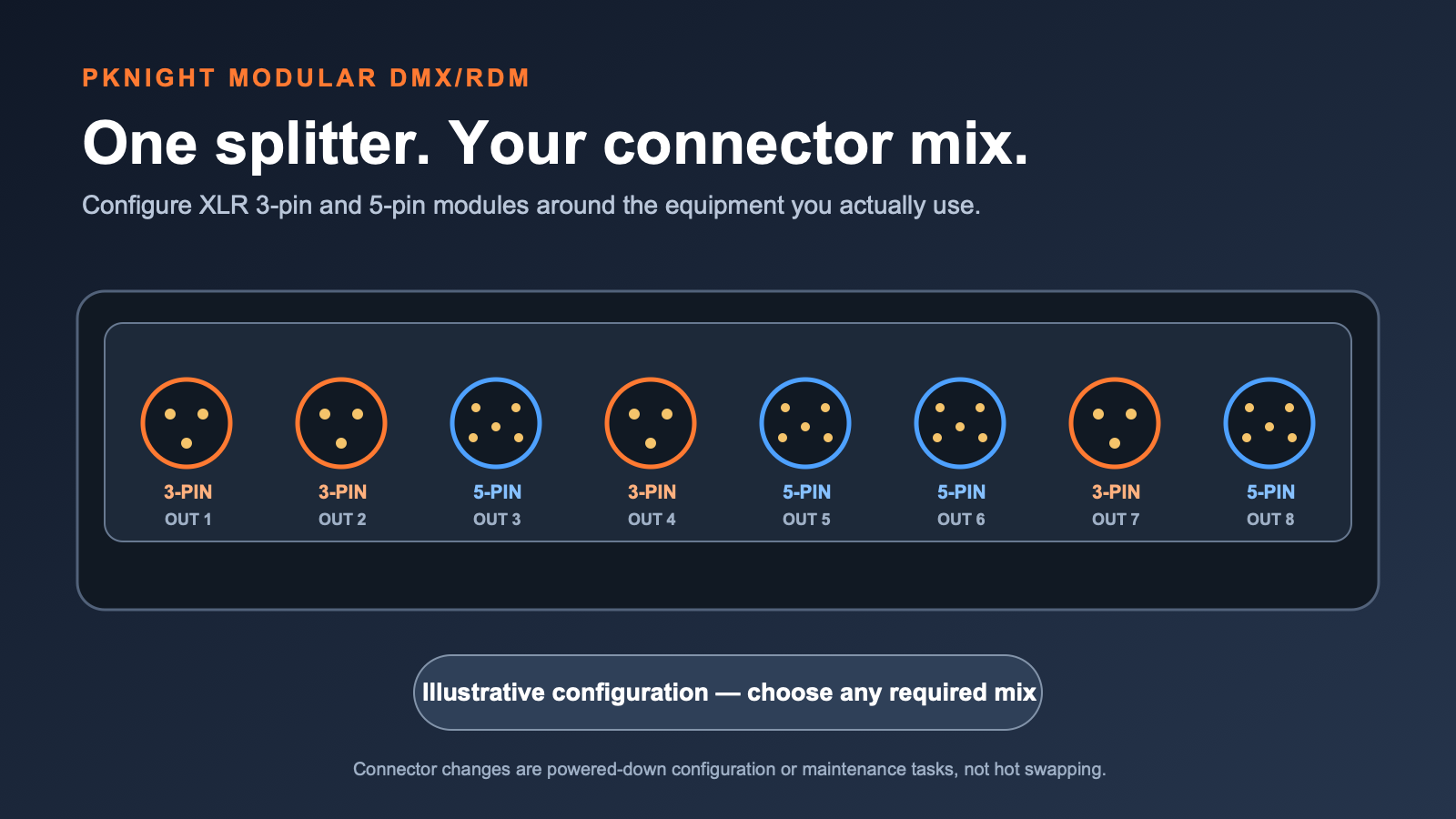
A rental shelf may contain older fixtures with 3-pin DMX, newer equipment with 5-pin connectors, and customer-supplied devices that arrive in either format. A theater may have a 5-pin infrastructure but still own a useful group of 3-pin effects. A touring rack may need to serve a different fixture package next month than it does today.
The usual answer is to carry adapters, dedicate separate splitters to each connector type, or accept a front panel that never quite matches the job. All three approaches can work. None is especially elegant when the requirement is known before the rack is built.
The Pknight RDM8802Mod-B offers a more flexible answer: its input and output XLR connectors are individual plug-in modules, and one splitter can be configured with the required combination of 3-pin and 5-pin modules. Instead of forcing the equipment fleet to fit one permanent connector layout, the panel can be planned around the real system.
That is more than cosmetic customization. It can simplify prep, reduce adapter chains, support gradual equipment upgrades and make every port easier to understand.
The short answer: yes, the connector mix can be personalized
The RDM8802Mod-B is an eight-output DMX512/RDM splitter with two routing options: one input distributed to eight outputs, or two independent inputs distributed to four outputs each. Every input and output connector is built as a replaceable module. Pknight can therefore configure the unit with XLR 3-pin modules, XLR 5-pin modules, or any required combination and placement of the two formats.
For example, a customer could specify four 3-pin outputs and four 5-pin outputs. Another rack might need six 3-pin and two 5-pin outputs. A system moving toward a 5-pin standard might retain two 3-pin ports for legacy fixtures while assigning the remaining outputs to 5-pin.
The connector layout should be confirmed when ordering, including the input configuration, output positions and compatible spare modules. Later changes are powered-down configuration or maintenance tasks—not hot swapping.

The production photo shows one all-3-pin configuration. The modular design allows a specified mix of compatible 3-pin and 5-pin modules.
Why professional lighting inventories contain both formats
The practical lighting market is mixed. Many professional consoles, nodes, fixtures and installed systems use 5-pin XLR. At the same time, a large amount of working stage equipment uses 3-pin XLR. Rental companies and venues rarely replace every cable and fixture at once, so both formats can remain in active service for years.
This creates three reasonable connector strategies:
- A 3-pin panel works well when nearly the entire equipment fleet is 3-pin.
- A 5-pin panel supports a standardized 5-pin infrastructure.
- A mixed panel fits projects that regularly serve both formats.
Pin count alone does not make the DMX data “stronger” or “better.” Signal reliability depends on the complete system: correct wiring, suitable cable, termination, topology, electrical isolation and equipment condition. Connector choice should be treated as a workflow and compatibility decision.

Why a mixed panel can be better than an adapter bag
Adapters remain useful when an unexpected fixture appears or when a temporary system needs one conversion point. The problem begins when adapters become the permanent architecture of the rack.
Fewer loose connection points
Every adapter adds another connector pair that must be packed, labeled, inspected and tested. A panel with the correct socket already installed removes that extra mechanical junction from the normal patch.
Faster equipment preparation
When outputs already match the destination equipment, technicians can patch directly from the labeled port. They spend less time searching cases for the right adapter and less time checking whether an adapter was returned after the previous job.
Clearer troubleshooting
A port labeled “Stage Left Wash — 5-pin” communicates more than a generic output followed by an unlabeled adapter. When a line fails, the technician can see the intended connector type and destination immediately.
A cleaner rack
Reducing short adapter tails and improvised conversion points makes the front of the rack easier to inspect. That is especially useful in a dark backstage area where cable management and readable labels matter.

“Any mix” means the panel can follow the business
The strongest benefit of modular connectors is not that every panel should look different. It is that the panel can reflect a deliberate operating model.
Rental company: a balanced general-purpose rack
A rental company serving many customer fixture packages might choose four 3-pin and four 5-pin outputs. The rack can support either connector family without dedicating an entire second splitter to the less common format.
Theater: protect the value of legacy equipment
A theater may have mostly 3-pin fixtures but be adding new 5-pin equipment over time. A six-plus-two layout keeps the current inventory useful while providing dedicated outputs for the newer package.
Phased upgrade: move toward a new standard gradually
A company standardizing on 5-pin does not have to convert every branch on the same day. Two 3-pin outputs can remain available for known legacy devices while six 5-pin outputs support the preferred future workflow.
These are examples, not fixed presets. Because the connectors are individual modules, the required count and positions can be specified around the actual project.

Connector format and signal routing are separate decisions
It is important not to confuse the connector layout with the splitter’s routing mode.
In Normal mode, DMX Input A is distributed to all eight outputs. Those outputs may be equipped with the chosen 3-pin/5-pin combination, but they carry the same input line.
In Split mode, Input A feeds outputs A1–A4 and Input B feeds outputs B1–B4. The connector type on each port does not decide which input it follows; the A/B routing and front-panel labeling do.
This separation creates useful flexibility. A four-plus-four signal split does not require a four-plus-four connector split. Group A could contain a mixture of 3-pin and 5-pin outputs, and Group B could use a different mixture, as long as the configuration is planned and documented correctly.

RDM support still depends on the complete signal path
The RDM8802Mod-B supports both DMX512 distribution and RDM bidirectional communication. A mixed 3-pin/5-pin panel can therefore be part of an RDM workflow, but the connector module is only one part of the system.
The controller, splitter, cables, adapters where used and end devices must all be wired and configured correctly for RDM. Mixing connector formats does not automatically convert an incompatible fixture into an RDM device, and changing pin count does not change the DMX universe carried by the port.
The splitter also uses independent power and optical isolation for its channels. Those electrical features address branch separation and interference; the replaceable connector modules address physical compatibility and service. They complement each other without being the same feature.
How to design a mixed 3-pin/5-pin panel
A good custom layout begins with an equipment audit, not a guess.
- Audit the fleet. Count the connector formats used by fixtures, cables, stage boxes and the most common customer packages.
- Assign outputs by purpose. Decide which ports serve specific zones, fixture groups or rental packages.
- Choose the physical order. Grouping similar connectors can make the panel easy to scan, while deliberate alternation may suit a zone-based rack. Pick one system and document it.
- Label every port. Include the connector format, signal group and destination where practical.
- Plan compatible spares. Keep the correct input and output modules available, with part identity recorded.
- Define the change procedure. Disconnect power, fit the correct compatible module, secure it properly, then test DMX and RDM operation before returning the port to service.

Personalization is most valuable when it remains organized
An arbitrary connector mix without labels or documentation can create more confusion than a standardized panel. The value comes from intentional customization.
For a rental house, that may mean a standard four-and-four rack with the same port order across every unit. For a theater, it may mean outputs grouped by stage zone. For an integrator, it may mean matching the connectors already installed in wall plates and floor boxes. The layout is personalized, but the operating method remains repeatable.
This is also why replaceable modules should be treated as managed parts. Record which modules are installed, which spares are compatible and how technicians should test the line after a change. The physical flexibility is high-end only when the operational discipline matches it.

A splitter that adapts to the system—not the other way around
Most DMX splitters ask the buyer to choose one connector format and live with it. That is acceptable for a fully standardized system. It is less helpful for a mixed rental fleet, a venue in transition or a custom rack designed around several equipment families.
The modular connector design of the Pknight RDM8802Mod-B changes that relationship. XLR 3-pin and 5-pin modules can be combined in the quantity and positions the project requires. If the requirement changes later, compatible modules can be replaced during powered-down service instead of treating the front panel as permanent.
The result is not customization for its own sake. It is a rack that reflects the real cables, fixtures and technicians using it.
Explore the Pknight RDM 8-Channel Modular DMX512/RDM Splitter, and contact Pknight with your preferred input/output connector map for a personalized 3-pin and 5-pin configuration.
FAQ
Can one Pknight splitter contain both 3-pin and 5-pin XLR modules?
Yes. The modular inputs and outputs can be configured with the required combination and placement of compatible 3-pin and 5-pin modules. Confirm the exact connector map when ordering.
Can I change the connector mix later?
Yes, compatible modules can be replaced individually. Treat the change as a powered-down maintenance or reconfiguration task, not a hot-swap operation, and test the port before use.
Does a 5-pin connector produce a better DMX signal than a 3-pin connector?
Pin count by itself does not improve signal quality. Reliable DMX depends on correct wiring, appropriate cable, termination, topology, isolation and equipment condition.
Does mixing connectors change the 1×8 or dual 1×4 routing?
No. Routing mode determines which input feeds each output group. Connector type determines the physical interface on that port.
Can both connector types carry RDM?
The splitter supports RDM, but the complete path must be compatible and wired correctly, including controllers, cables, any adapters and fixtures.
Will a mixed panel eliminate every adapter?
It can reduce the adapters required for normal, planned connections. Keeping a small number of verified adapters may still be useful for unexpected equipment.