
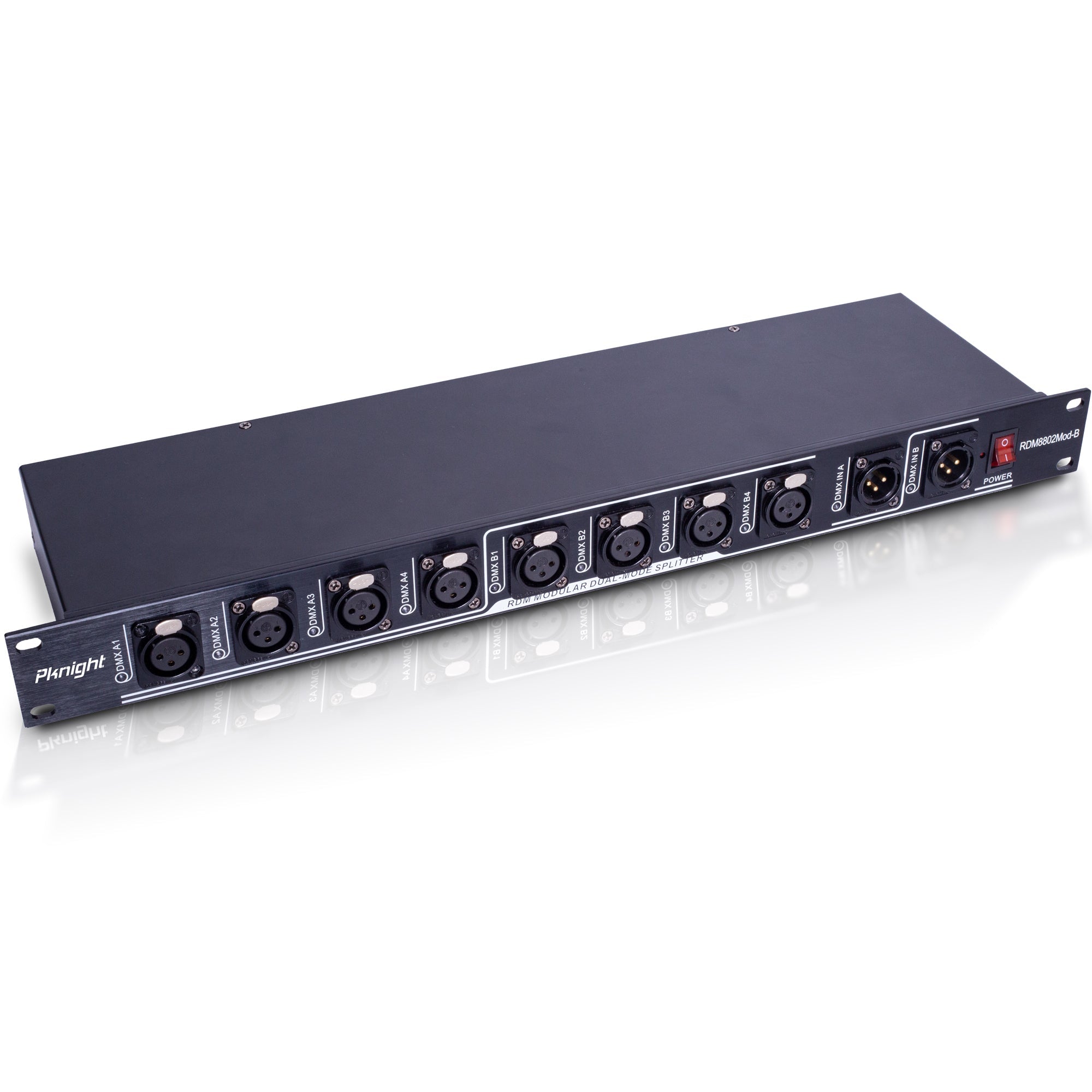
In a working lighting system, the connector is where the abstract DMX network meets the physical world. It is grabbed, patched, repatched, loaded into a truck, installed in a rack and sometimes pulled at an angle by a cable that should have had better strain relief. That makes the XLR socket one of the most exposed parts of a splitter—even when the electronics behind it are still healthy.
This is why a replaceable connector can be more important than another line on a specification sheet.
The Pknight RDM8802Mod-B is a 1U, eight-output DMX512/RDM splitter that can operate as one 1-in/8-out distributor or as two independent 1-in/4-out groups. Its most distinctive feature, however, is visible from the front: every input and output XLR is built as an individually replaceable plug-in module. If a connector is damaged or worn, the affected module can be removed from the front without opening the chassis.
That small mechanical decision changes how the splitter can be maintained, stocked and kept in service.

The expensive part of a failure is often the repair scope
When a conventional rack splitter develops a damaged connector, the visible fault may be small, but the service task can be large. The unit may need to come out of the rack, be opened on a bench, have internal wiring disconnected, or be sent away for repair. Even if seven outputs remain usable, the equipment manager now has to decide whether to deploy an incomplete unit, label a dead port, or remove the whole splitter from inventory.
A plug-in port module narrows that repair scope. On the RDM8802Mod-B, the connector and its small circuit board form a removable assembly secured at the front panel. The product page states that input and output modules can be replaced individually without opening the chassis. In practical terms, the service unit becomes one port rather than the entire rack device.
This does not mean the splitter is hot-swappable, and it does not mean every signal problem is caused by a connector. Power should be disconnected before service, the fault should be diagnosed first, and only a compatible replacement module should be fitted. But when the physical XLR assembly is the problem, access from the front can make the intervention far more focused.

Four ways modular connectors create professional value
1. Faster recovery from common physical damage
Rental and touring equipment lives around repeated connections, tight racks and frequent handling. A bent contact, loose socket, worn latch or impact-damaged connector can take an otherwise functional splitter out of its assigned role. With a compatible spare module available, a technician can replace the affected assembly instead of immediately treating the entire splitter as a bench-repair job.
The real advantage is not a promise that failures will never happen. It is a more manageable response when they do.
2. A cleaner 3-pin and 5-pin strategy
DMX systems in the real world include both XLR 3-pin and XLR 5-pin equipment. Adapters can solve an occasional mismatch, but adapter chains add patch points, consume rack space and complicate troubleshooting. The RDM8802Mod-B is offered for 3-pin and 5-pin connector requirements, while its modular construction makes the connector format a replaceable assembly rather than a permanently buried part of the chassis.
For a venue or rental company, that supports a better planning conversation: which connector format should be standard in this rack, which compatible modules should be held as spares, and how will each module be labeled? Confirm the required connector configuration and replacement-module compatibility with Pknight before ordering.
3. Lower lifecycle disruption
Purchase price is only one part of professional equipment cost. Downtime, shipping, technician time, spare-unit requirements and lost availability all matter. A port-level replacement does not eliminate those costs, but it can reduce the amount of equipment involved in a connector repair.
This is especially useful when a company owns a fleet of identical splitters. A small, documented spare-module kit can be easier to store and count than keeping an extra complete rack unit solely for connector faults. It also lets the maintenance record identify exactly which port assembly was changed and why.
4. A design that complements electrical isolation
Mechanical serviceability and electrical protection solve different problems. The modular XLR assembly addresses the physical connection point. The splitter’s independent power and optical-isolation design addresses signal separation and electrical interference between branches. The product also includes terminal-resistance and surge-protection design.
Together, these features show a useful engineering principle: divide a system into sections that are easier to isolate, diagnose and service. Optical isolation is not a substitute for correct grounding, cabling or system practice, and a replaceable port is not a substitute for troubleshooting. They are complementary layers.

More than modular sockets: two useful routing modes
The RDM8802Mod-B can be configured for two common distribution patterns.
In Normal mode, DMX Input A is distributed to all eight isolated outputs. This is the familiar 1-in/8-out arrangement for sending one DMX line to multiple fixture branches, stage areas or cable routes.
In Split mode, DMX Input A feeds outputs A1–A4, while DMX Input B feeds outputs B1–B4. The same 1U device then behaves as two independent 1-in/4-out splitters. This can simplify a rack that needs to carry two separate DMX lines without installing a second splitter.
The routing labels matter. A clearly marked A/B layout helps a technician trace the signal path under time pressure and reduces dependence on memory or improvised tape notes.

Why RDM support belongs in the same conversation
DMX512 carries control data from the controller toward fixtures. RDM adds compatible two-way communication so a controller can discover and configure supported devices over the same data infrastructure. A splitter used in an RDM workflow must pass that bidirectional exchange correctly; a one-way DMX-only distribution path is not enough.
The RDM8802Mod-B supports both DMX512 and RDM. This matters in venues, studios and touring systems where remote discovery, addressing and status access can reduce the need to reach every fixture physically. RDM operation still depends on compatible controllers, fixtures, cabling and correct system configuration.

Where this design earns its place
Touring and rental racks
Equipment must be checked, repaired and returned to inventory quickly. Replaceable connector modules can reduce the scope of a physical-port repair, while the 1×8 / 2×4 routing choice gives the same rack unit more than one job.
Theaters and performance venues
A fixed rack may serve for years while its front-panel connections see repeated use. Front-accessible modules support planned maintenance without making the entire splitter disposable when one connector wears out.
Broadcast and production studios
Downtime windows can be short, and rack access may be limited. A serviceable front connection is easier to work into a controlled maintenance procedure than a repair that begins by opening the chassis.
Fixed architectural and event installations
Optical isolation, signal amplification and distribution are valuable on branched DMX runs. Modular connectors add a lifecycle benefit: the exposed interface can be treated as a replaceable part of the installation.

A practical buying and spares checklist
Before specifying any professional DMX/RDM splitter, ask questions that go beyond output count:
- Routing: Do you need one line distributed eight ways, or two lines distributed four ways each?
- Connector format: Is the rack standardized on XLR 3-pin, XLR 5-pin, or a defined combination approved for the build?
- Replacement parts: Which input and output modules are compatible, and how many should be kept as spares?
- Service method: Can a connector assembly be replaced from the front, and what power-down and test procedure should technicians follow?
- Isolation: Are branches optically isolated, and how is power separated?
- RDM: Does the complete signal path—including controller, splitter, cabling and fixtures—support bidirectional communication?
- Rack workflow: Are inputs, outputs, mode settings and A/B groups easy to identify in low light?
- Verification: After any repair, is there a documented test for both DMX control and RDM communication where RDM is used?
A modular design delivers its greatest benefit when the operational plan is modular too: matched spares, clear labels, a power-down rule and a repeatable function test.

The mark of high-end equipment is not complexity—it is control
High-end professional hardware is sometimes described only by how many features it has. A better measure is how much control it gives the operator over failure, change and maintenance.
The replaceable XLR modules on the Pknight RDM8802Mod-B are a good example. They do not make the connector indestructible. They make the connector a defined, accessible and replaceable part. Add flexible 1×8 or dual 1×4 routing, DMX512/RDM support, independent power and optical isolation, and the result is a splitter designed not just to distribute a signal today, but to remain practical through years of patching and service.
That is the difference between a box with many sockets and a piece of infrastructure designed around real technicians.
Explore the Pknight RDM 8-Channel Modular DMX512/RDM Splitter, and contact Pknight to confirm the connector configuration and compatible replacement modules for your rack.
FAQ
Can the XLR modules be replaced without opening the chassis?
Yes. According to the product information, each input and output module can be replaced individually from the front without opening the chassis. Disconnect power and follow the correct service procedure.
Are the connector modules hot-swappable?
No hot-swap capability is claimed. Treat replacement as a powered-down maintenance task, use a compatible module, and test the line before returning it to service.
Can the splitter run one or two DMX lines?
Yes. Normal mode distributes one input to eight outputs. Split mode creates two independent groups: Input A to four A outputs and Input B to four B outputs.
Does it support RDM as well as DMX512?
Yes. The splitter is designed for DMX512 distribution and RDM two-way communication. Every other part of the system must also be RDM-compatible for an RDM workflow.
Is it available for both 3-pin and 5-pin XLR systems?
The product is offered for XLR 3-pin and 5-pin connector requirements. Confirm the required build and the exact compatible spare-module options with Pknight before purchase.
Why is optical isolation important in a DMX splitter?
Optical isolation helps separate output branches and reduce the propagation of electrical interference between sections of a system. It complements—rather than replaces—correct cabling, grounding, termination and troubleshooting practice.